You reached into the back seat, or you woke up with your neck at a bad angle, and now a hot stripe of pain runs from your shoulder into your thumb. Maybe it's your leg instead. Either way, almost everyone asks us the same thing first: how long?
That question has a real answer. Folklore keeps getting in the way. What patients bring in often does not match what spine specialists see day to day: how long symptoms usually run, why a herniated disc can shrink without surgery, what an early scan can and cannot tell you, why some arm and leg symptoms never started in the spine at all, what to make of home traction gadgets, and the warning signs that mean waiting is the wrong move.
A quick definition first. A pinched nerve happens when one of the nerve roots branching off your spinal cord gets irritated, squeezed, or both. Usually the cause is disc material, or the bony and soft tissue changes that come with years of wear. Doctors call the shooting pain radicular pain, and when numbness or weakness shows up with it, radiculopathy. Nerve compression in the thoracic spine, meaning the upper and mid back, is rare, and when it does happen it usually needs medical treatment.
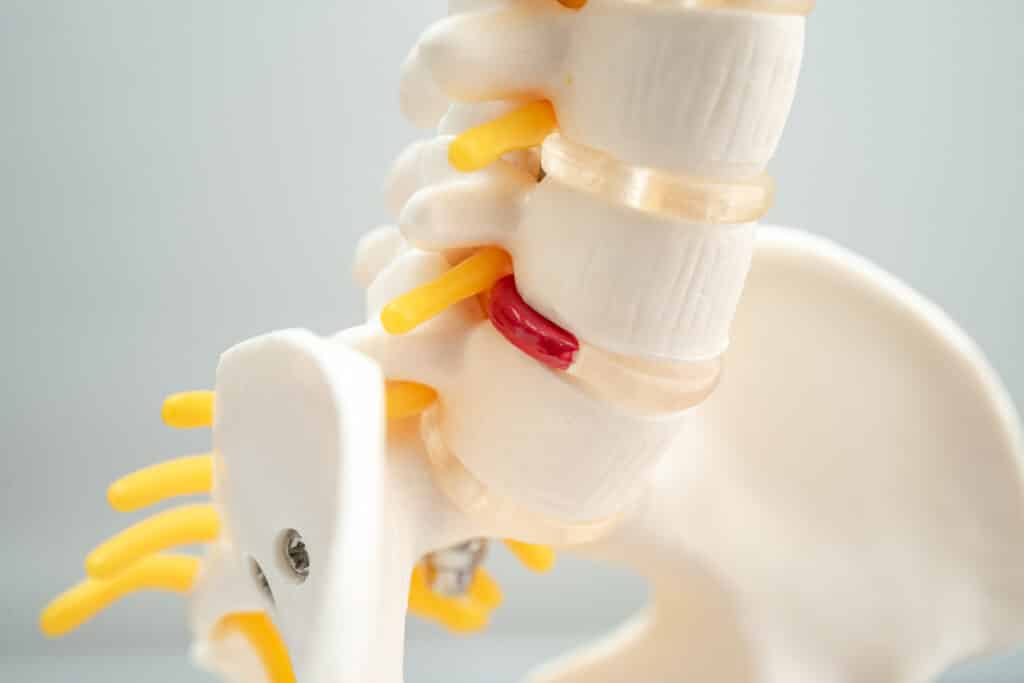
Some people do get lucky and turn the corner in under a week. Plenty do not, and that is not a sign something has gone wrong.
In the low back, many nerve cases settle within a couple of weeks, and most quiet down within a few months. The neck tends to run slower, but most people still improve within a few months without any special treatment, and many keep getting better over the following year or two.
Pain that is still with you past twelve weeks is considered chronic, and at that point it usually needs some form of medical treatment rather than more waiting.
Timelines like these are typical, not promises. Your own timeline depends on what is pressing on the nerve, how irritated it is, and how the rest of your spine is holding up.
Here's the part most people have never been told. The body often reabsorbs herniated disc material over time. On follow-up imaging, the fragment pressing on a nerve root can be smaller, and sometimes it's gone.
The body gradually dries out the displaced disc material and clears it away. The timing varies a lot, from a couple of months to a couple of years. Oddly enough, the larger, more dramatic-looking herniations often shrink more readily than small bulges.
Two caveats matter. Your symptoms and your scan do not always improve on the same schedule, so feeling better before the disc changes is common and perfectly fine. And none of this replaces surgery when weakness is progressing or pain has stopped responding to everything else, which is a conversation to have in person.
Imaging is a map, not a forecast. Disc bulges, worn discs and narrowed openings often show up in people with no pain at all, and they become more common with age.
A scan can hint at whether a herniated disc is likely to shrink, but it can't predict how your pain will go. A scary-sounding report can belong to a back that's about to feel much better, so we treat you based on your exam, not the report.
Red flags change that. Signs of infection, cancer, a fracture, or pressure on the spinal cord need imaging right away. Otherwise, scans are saved for a short list of situations:

Long stretches of bed rest fell out of favor years ago. Stiffness builds, conditioning fades, and the nerve is no happier for it.
What helps in the early weeks is plain and a little boring. Small choices repeated across the day usually matter more than any one treatment, and most of them cost nothing but attention and patience:

Often it is. Not always, though, and that mix-up is one of the more common reasons a pinched nerve seems to drag on with no clear explanation.
A handful of other conditions can produce tingling, burning, or weakness that looks close enough to a nerve root problem to fool almost anyone on the first pass, clinicians included. These are the ones that come up most often during a first office visit:
Sorting this out is an in-person job. An examination, and sometimes nerve testing, does far more for you than another scan.
Traction has a sensible theory behind it, which is gently opening space around the irritated nerve root. Therapists do use it. The evidence, though, is mixed, and what exists mostly points to short-term relief rather than a cure.
Traction is also not appropriate in some situations. Suspected cervical myelopathy, instability in the neck, inflammatory arthritis such as rheumatoid arthritis, infection, tumor, or vertebral artery insufficiency all rule it out. Home units and traction pillows are sold freely, and pulling on a neck that has never been properly diagnosed can make symptoms worse. The position that eases one person's nerve can aggravate another's, so talk with a clinician first.
Most pinched nerves are a patience problem, and time does most of the work. A small number are not, and those few need sorting out quickly, because nerve tissue does not tolerate pressure for long. Go to emergency care now if you have any of the following:
That first group of symptoms can signal compression of the nerve bundle at the bottom of the spinal canal, and it's treated as an emergency because the window to protect nerve function is short.
Signs that the spinal cord itself is being squeezed in the neck, a condition called cervical myelopathy, sit in their own category. They are not an ordinary pinched nerve, and they should not wait for a routine opening on the schedule. Get evaluated the same day or the next day if you notice:
Myelopathy that is getting worse quickly, or weakness anywhere that is getting worse quickly, is an emergency rather than an urgent appointment. Go straight to emergency care.
Plenty of symptoms fall below the urgent line but still deserve a real examination instead of another few weeks of guessing. If any of the following describe your situation, call and get on the schedule, even if the pain itself feels manageable most of the day:
We start with your story, because the pattern of the symptoms usually points to the level involved before anyone orders anything. Then we examine you: strength, sensation, reflexes, and how your neck or back moves.
From there, care is built around what you can do rather than what a report says. That may mean activity guidance, physical therapy, medication reviewed with your provider, or an injection if symptoms are stubborn. Surgery enters the conversation when weakness is progressing, or when well run non-surgical care has had a fair trial and has not held. Most people never get there.
Most people recover well. Some numbness or mild weakness can linger after severe or long lasting compression, though, and motor loss that has been there a long time may not fully reverse. That is the reason weakness should be looked at early rather than waited out.
Either can help, and many people alternate. Ice tends to suit a hot, freshly irritated nerve in the first days or weeks, while heat often feels better when the muscles around the area are guarding. Put it on the neck or low back where the nerve root is, not only on the arm or leg where you feel the symptoms. One safety rule matters here: never put heat or cold directly on numb skin. Use a cloth barrier and keep each application to about fifteen to twenty minutes, since reduced sensation raises the risk of burns and frostbite.
Irritated nerves are sensitive to position, activity, and sleep. Fluctuation is expected early on. What matters more than any single bad day is the trend across a couple of weeks.
Usually, with adjustments. Anything that leaves your arm or leg symptoms worse for hours afterward is worth pausing or modifying. Bring your list of aggravating movements to your appointment so we can work around them.
If you're only a few days in, keep moving gently and note what eases the symptoms. If the pain is severe, if you notice new or worsening weakness, or if things are no better after about one to two weeks, book an exam with an OrthoNJ provider so we can identify which nerve is involved and give you a plan with a realistic timeline.
This information is for general education and is not a substitute for medical advice from a qualified provider. The timelines described here are typical ranges, not predictions for any one person. If you have symptoms that concern you, please seek care.
This treatment info is for informational purposes only. Treatment and recovery vary person to person, and you should consult with your treating physician and team for details on your treatment and recovery process.
Contact one of OrthoNJ's locations spread out through all of New Jersey.