Mallet finger is an injury to the extensor tendon that straightens the end joint of a finger. When that tendon tears or pulls away from the bone, sometimes taking a small chip of bone with it, the fingertip droops and cannot straighten on its own. Mallet finger is also known as baseball finger or drop finger.
The injury usually happens when something strikes the tip of a straight finger and forces it to bend: a ball, a mattress while making the bed, or a fall. At first it can look like an ordinary jammed finger. The drooping fingertip is what sets it apart, and because pain is often mild, many people wait before having it checked.
Most mallet finger injuries are treated without surgery, using a splint that holds the end joint straight full time for about 6 to 8 weeks. This guide covers mallet finger symptoms, how the injury is diagnosed, splint and skin care, recovery time, and the situations where surgery or a same-day visit may be needed.
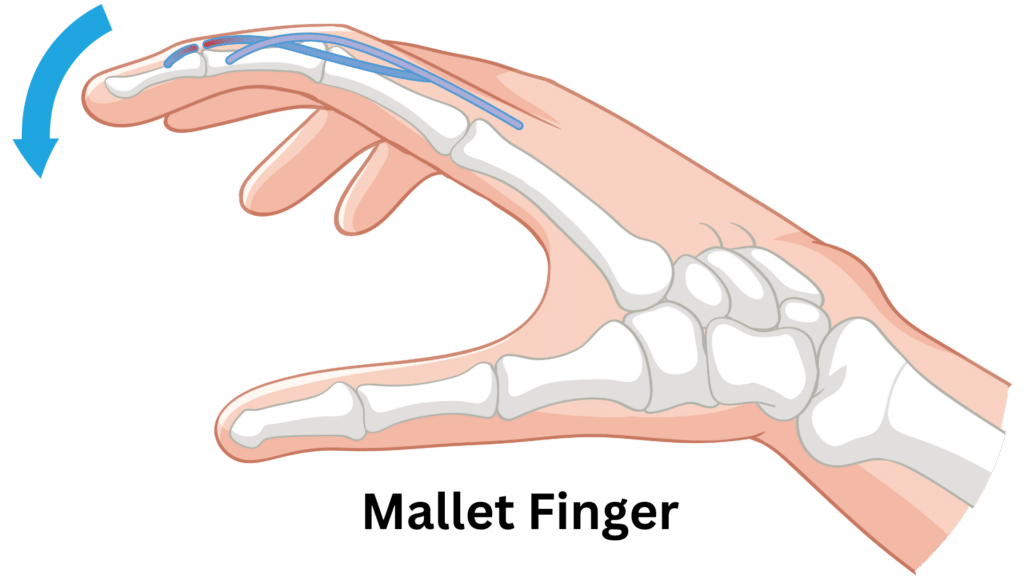
A slim tendon runs along the back of your finger and attaches to the last small bone. It's the main structure that lifts the fingertip. When the tip is forced to bend suddenly, that attachment can tear, or it can peel off a fleck of bone. Either way the lifting mechanism is disconnected, so the tip drops while the rest of the finger works normally.
Plenty of jammed fingers are sore and puffy for a week or two, yet they still straighten when you ask them to. A mallet finger doesn't, and the difference usually shows up within the first day or so. Here is what tends to stand out:
Ball sports account for plenty of them. So does tucking in bedding, catching a finger on clothing, or breaking a fall, which surprises people who expect an injury like this to come from something dramatic.
We will look at how the tip sits, test whether you can lift it yourself, and check the skin around the joint and nail. An X-ray usually follows.
The X-ray answers two questions. Did the tendon pull a piece of bone away, and is the end joint still lined up the way it should be? A tendon-only injury and a small bone chip are generally handled the same way, with a splint. A joint that has slipped out of alignment is a different conversation, and that is the finding that most often leads to a hand surgery referral.
Holding the end joint straight brings the torn ends back into contact and keeps them there while scar tissue forms. Take the pressure off for even a moment and the repair can lengthen, which is how a lasting droop develops.
There are several reasonable splint designs. A molded plastic cap, a padded aluminum splint along the back of the finger, and a custom splint made by a hand therapist are all used. Current guidance from hand surgery groups puts non-surgical care first for the large majority of these injuries.
Research keeps landing on the same point, and it has nothing to do with the brand of splint. What counts is whether the joint actually stayed straight for the whole stretch. That part is yours.
One caution: splints improvised from household objects can pinch the finger and press hard enough to damage skin, and they often hold the tip in slight bending, which is the opposite of what you need.
Weeks inside a splint are hard on skin, and skin trouble is one of the most common reasons people give up on treatment early. Sweat plays a part, and so do rubbing and steady pressure. A few simple habits prevent most of it, and they take only a minute or two each day:
Some people do better with two splints of slightly different designs, switching between them so pressure doesn't fall on the same spot day after day. Your provider or hand therapist can set that up.
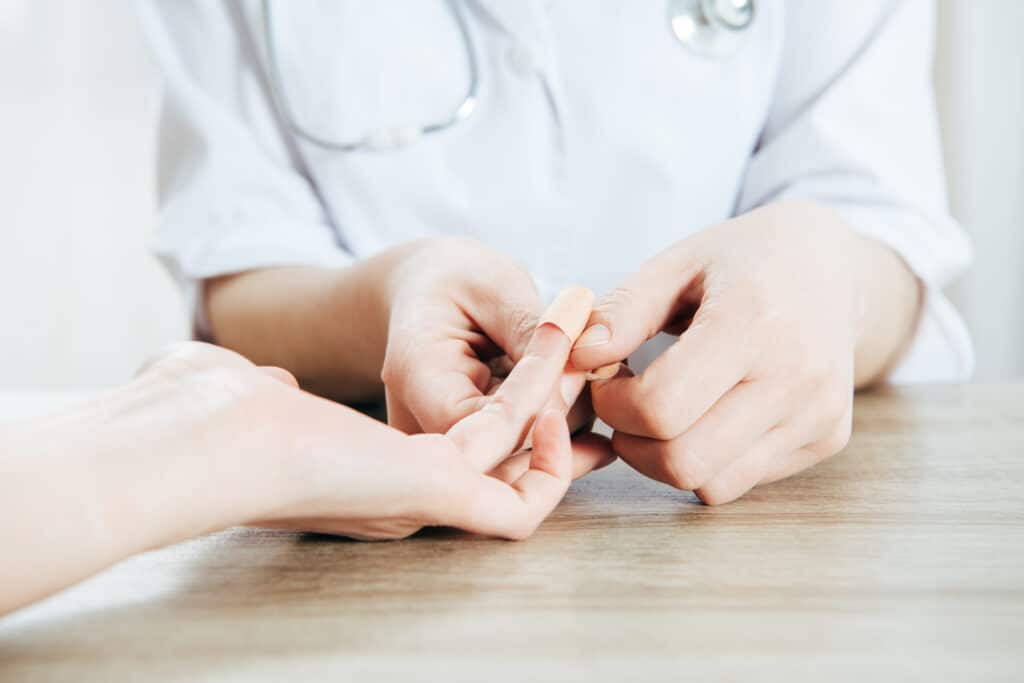
This is the part nobody explains well, and it's where treatment quietly fails.
Rest your hand palm down on a table or counter so the fingertip is supported by the flat surface. Slide the splint off along the table, keeping the tip pressed lightly against it so the joint never bends. Clean and dry, then slide the splint back on the same way. Use your other hand to help, or ask someone to do it with you for the first week.
Resist the urge to test the finger. Lifting the tip to see whether it works yet is the single most common way people undo weeks of healing, and if the tip bends during the full-time phase, many providers will ask you to restart the count from day one.
Only the end joint is meant to be still. The middle knuckle of the injured finger should keep bending normally, and your other fingers, thumb and wrist should move through their usual range every day.
With the splint on, you should still be able to curl that finger until the end of the splint reaches your palm. If the splint blocks that, it likely runs too far down the finger and past the middle knuckle, and we should refit it.
The splint does not simply come off and stay off. Most people move into a weaning stage: the splint comes off for light activity such as dressing or eating, and goes back on at night and for anything involving a firm grip, usually for another few weeks.
Expect the joint to feel stiff and look a little swollen at first. Gentle movement, done briefly and often, tends to work better than long sessions. If the droop reappears as you wean, go back to full-time splinting and call us rather than waiting it out.
A small lasting droop or a firm bump over the joint can remain even after a good recovery. For most people, neither one limits what the hand can do. A slight extensor lag of roughly 10 degrees or less is common after both splint treatment and surgery, and it typically does not reduce hand function. Larger droops are often still tolerated well, since most daily tasks rely on the fingers bending rather than on the tip sitting perfectly straight.
Not every drooping fingertip is a simple splint case, and a few findings change the plan right away. Some point to an open injury, some to a joint that has slipped out of place, and some to a blood flow problem. Get seen promptly if any of these apply to you:
Open fingertip injuries need the wound cleaned, a tetanus update if you're due, and often antibiotics, so they should not simply be splinted at home.
Severe injuries, including anything with heavy bleeding or a finger that may be partly cut off, belong in emergency care.
In children and teenagers, an injury that looks exactly like a mallet finger can actually be a break through the growth plate at the base of the nail, with the nail bed torn as well. The nail may sit up on top of the cuticle, or there may be a little bleeding there.
They are not the same injury. A Seymour fracture runs through the growth plate at the base of the nail, sits outside the joint, and comes with a nail bed injury. A true bony mallet in a child is a break into the joint surface itself, and that one can often be treated with a splint.
Nail fold findings are what move a child's injury into the urgent column. A nail sitting on top of the cuticle, bleeding at the cuticle, or blood under the nail all suggest the break is connected to the outside through the nail fold, which makes it an open injury. Delayed or incomplete treatment can lead to infection in the bone, a nail that grows in abnormally, or a growth plate that stops growing properly.
Care typically includes cleaning the wound, putting the bone back in position, checking that tetanus coverage is up to date, antibiotics and sometimes a procedure in the operating room. A splint alone is not enough. If your child's fingertip droops and the nail area looks disturbed, have it checked the same day.
Surgery is the exception here, not the rule, and most mallet fingers never need it. Still, a few situations shift the balance, usually because a splint cannot hold things where they belong or because the injury broke the skin. It tends to be considered when the following apply:
The usual approach uses a thin pin to hold the end joint straight from the inside while healing happens, sometimes along with fixing the bone fragment in place. It is generally an outpatient procedure. Pins come out in the office once healing allows, and protected splinting, plus hand therapy for stiffness, often continues afterward.
Surgery has its own risks, including infection around the pin, nail changes and stiffness, which is part of why splinting is usually tried first.
People often assume that once weeks have passed, the window has closed. It usually hasn't. Splinting an older mallet finger can still improve how the tip sits, and it is reasonable to try before anything else is considered. That trial is usually run for the same 6 to 8 weeks of full-time wear, followed by the same weaning stage.
There's a second reason not to ignore a long-standing droop. When the end joint stops straightening, the pull of the tendons shifts, and over time the middle knuckle can begin to bend backward. That combined position is called a swan neck deformity, and it is harder to treat than the original injury. Many long-standing droops are still tolerated well enough that surgery never becomes necessary, though reconstructive options exist for stubborn cases with real limits, and that is a discussion to have with a hand specialist after an exam.
Keep it on during the full-time phase unless you were told otherwise. If you remove it to wash, the tip has to stay supported and straight the entire time, and both the skin and the splint need to be dry before it goes back on.
Probably not. Late treatment can still improve the position of the fingertip, though earlier care tends to make the path simpler.
Many fingers come very close. A slight droop or a firm bump over the joint may stay, and most people find it does not interfere with daily use.
Sometimes, depending on the sport and whether the splint can be protected reliably. Ask before you return, because a knock that bends the tip during the healing weeks can set you back to the start.
Most of the time, a mallet finger is handled with a splint and a few follow-up visits. Things do come up between appointments, though, and calling early beats waiting for the next scheduled visit, since small problems with a splint can turn into bigger setbacks. Reach out to your OrthoNJ provider if:
Go to emergency care for an open wound with heavy bleeding, a finger that looks dislocated and deformed, or a fingertip that is numb and losing color.
If the tip of your finger has been hanging since an injury, schedule an exam rather than waiting to see whether it improves. We can take an X-ray, fit a splint that suits your hand and your work, show you how to change it safely, and set the follow-up schedule that gets you out of it on time.
This article is general orthopaedic education and is not a substitute for an evaluation. Timelines are approximate and not guarantees, since every injury and every hand is a little different.
This treatment info is for informational purposes only. Treatment and recovery vary person to person, and you should consult with your treating physician and team for details on your treatment and recovery process.
Contact one of OrthoNJ's locations spread out through all of New Jersey.